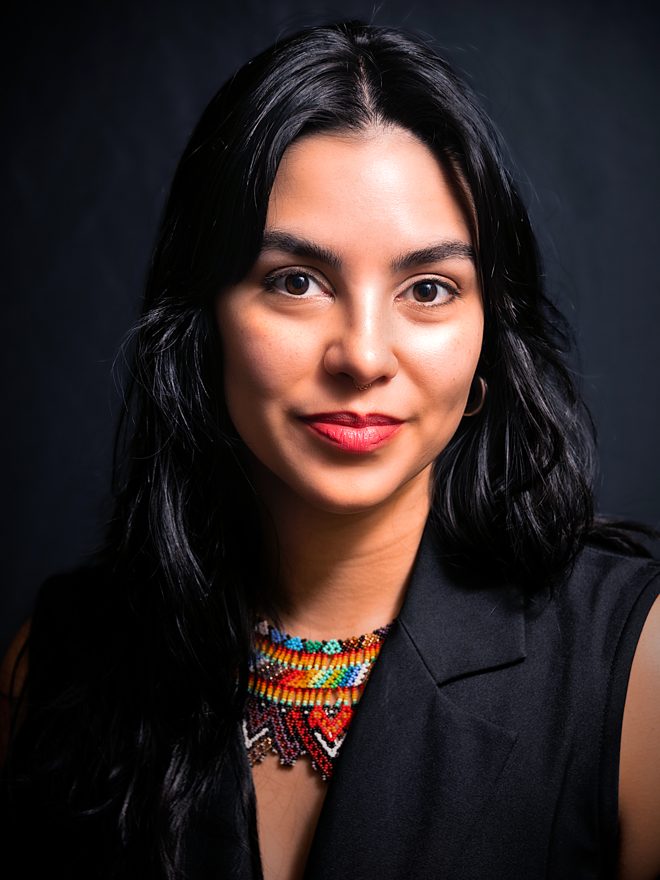
Renée Fonseca
Renée Fonseca, Human Genetics PhD candidate at the University of Chicago

Genetic predictions don't travel well. I work on why and build solutions for it.

I develop statistical methods that make genetic predictions more accurate across groups, populations, and datasets — integrating contexts like sex, age, and treatment status, and modeling population structure to ensure statistically robust results. Human Genetics PhD candidate in the Dahl lab at the University of Chicago, Ford Foundation fellow, and previously, a Fulbright researcher in Cali, Colombia.

Right now

Extending my locus-specific gene–context interactions method (PGSC) and on the job market for a post-PhD position. Also soldering a bluetooth antenna into a 2005 iPod that has no business still working.

Updated September 2026

In the lab

Genetic predictions are trained in one setting and applied in another — a different sex, a different age group, a different population, a different biobank — and they lose accuracy at every one of those boundaries. I build methods that maintain predictive accuracy across those moves and think about how to build and leverage more representative datasets.

Methods

PGSC: polygenic score method integrating locus-specific gene–context interactions

Standard polygenic scores assume a variant affects a trait the same way in everyone — it doesn't always. PGSC models genetic effects that vary with sex, age, and treatment status, improving prediction across 48 traits in the UK Biobank and replicating in an independent cohort at Mount Sinai. Code is available here.

Population structure and portability

Capturing signals of population structure within a dataset so their effects can be removed from GWAS and polygenic scores — one route to scores that transfer better between biobanks.

Phenotype scale in G×E tests

Contributed source code and analysis to work showing that gene–environment signals can appear or vanish depending on how a trait is measured. A caution for anyone reading interaction results, including my own (see how we accounted for scale here).

Populations

Glaucoma in an Afro-Colombian cohort

A Fulbright year at Universidad del Valle in Cali, working to identify genetic variants linked to glaucoma risk and treatment response in a population almost entirely absent from existing genetic studies. Concurrently, I helped organize a seminar series bringing genomic medicine findings to the wider public.

Genetic and oral histories in Southwest India

Whole-genome analysis of four communities in Southwest India, alongside oral histories collected from community members — with the two treated as distinct kinds of knowledge rather than one confirming the other. I contributed a genetic health analysis and worked on returning results to the participating communities. (paper)

See publications → See talks → See awards →

Teaching and outreach

Genetics taught to whoever is in the room. Graduate statistical genetics and undergraduate complex trait genetics at UChicago. Invited lectures in Spanish at Universidad del Valle and Universidad de los Andes. K-8 classrooms through COMBO and the South Side Science Festival, and panels for college students looking to enter the field.

Outside the lab

Hardware, infrastructure, and organizing. The same question runs through all of it: how was this built, and who was it for?

Organizing in academic workplaces

Elected representative for the graduate workers' union at UChicago, where I helped write and negotiate a first contract covering more than 3,000 researchers and teachers. I've since spoken about that work at the National Academies' Action Collaborative on Preventing Sexual Harassment in Higher Education and at the California Nurses Association annual convention.

Widening the applicant pipeline

Built a database of biology and computer science department contacts at HBCUs, HSIs, and TCCUs across the US to connect our PhD programs with applicants they weren't reaching. Also got a small grant to provide winter coats to students visiting Chicago.

UPWARD, a rare-disease data platform

Built at an NCBI hackathon: a HIPAA-compliant platform where people with rare genetic disorders can share their phenotypes and consumer-genetics results with researchers, cross-referencing their variants against ClinVar. A second-place team project, made for patients who rarely see themselves in genetic studies. Code · paper.

Network-wide DNS sinkhole

A Raspberry Pi filtering ads and trackers for every device on my network. Setup notes here.

iPod, resurrected

Rebuilt a click-wheel iPod on modern firmware. Flash storage, new battery, no music subscription (home server project coming soon).